An analemma is the path the Sun seems to draw when it is photographed from the same place at the same clock time over the course of a year [1][4].
Instead of finding the Sun in exactly the same place each day, you discover that it drifts. Sometimes it is higher, sometimes lower, sometimes a little to one side. If you keep repeating the observation, that drift slowly builds the familiar figure eight.
What you are looking at
The analemma is not a special effect and not a diagram invented afterwards. It is what appears when one fixed viewpoint meets one fixed hour and enough time passes. The curve is simply the Sun failing to return to the same point in the sky every day [1][5].
Why it rises and falls
Over the year, the Sun climbs higher in summer and stays lower in winter. That is the easy part to notice: the seasons change the Sun's height, so the analemma stretches vertically [1].
Why it leans left and right
Clock time and solar time do not stay perfectly aligned. Even if you go out at exactly the same hour, the Sun can appear slightly early or slightly late in the sky. That small mismatch produces the sideways drift that gives the analemma its pinched waist and uneven lobes [1][5].
Why it matters for this work
In solargraphy, the analemma turns abstract astronomy into a physical trace. It is a record of duration: the same Sun, the same place, the same frame, and a year of accumulated light written onto one surface [4].
Video: how the curve forms
The Stellarium animation makes the movement easier to grasp before it becomes a still image. What you see here is the yearly shift of the Sun when the place and the hour stay fixed.
A simple way to see the logic
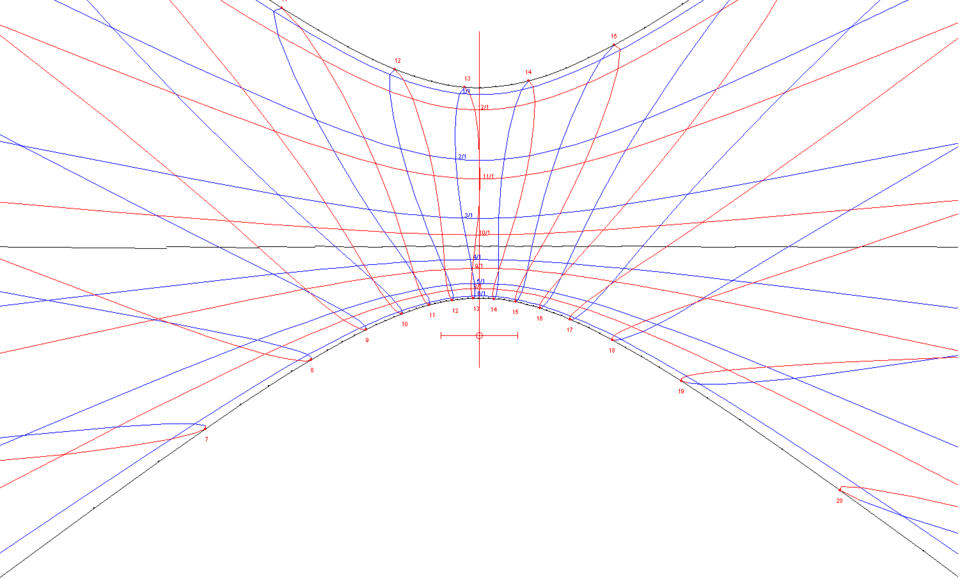
This sundial diagram helps because it shows the same idea without photographic complexity. The Sun does not cross the hour line in exactly the same way every day of the year. The analemma is that difference made visible [2].
Sundial face with analemmatic hour lines. Source: Wikimedia Commons [2].
A real example, not just a scheme
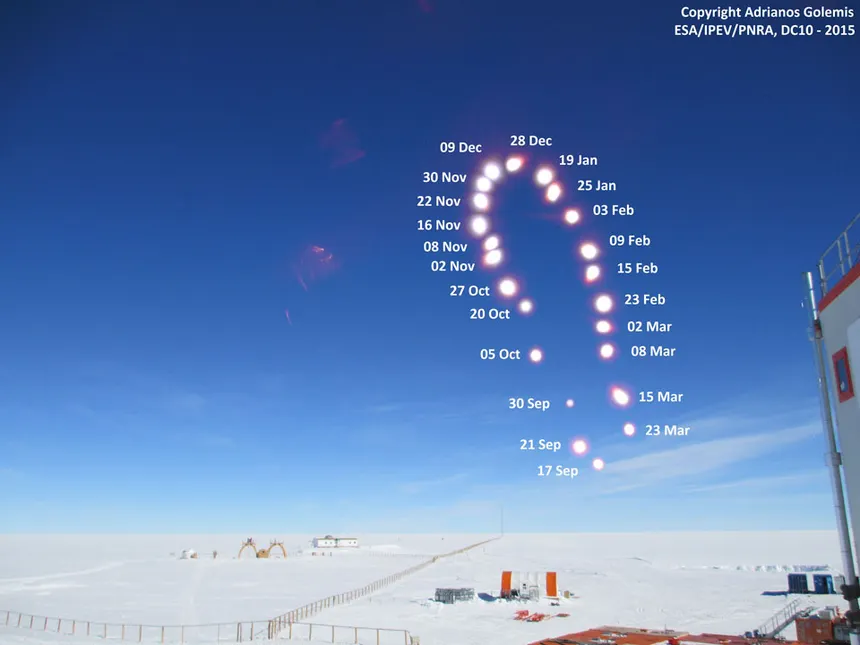
This Antarctic analemma by Adrianos Golemis is useful because it shows the phenomenon under real conditions. The trace is incomplete, and that is exactly the point: in Antarctica the Sun disappears below the horizon for part of the year, so the curve breaks where no sunlight could be recorded [3].
Antarctic analemma. Image credit: Adrianos Golemis via Observatorio.info [3].
Image sources
The supporting images on this page are credited to their original source pages below. One is used as a diagram to explain the geometry, the other as a photographic example of the phenomenon in practice.
Text and project credits
This page draws on the explanatory overview in Scientific American, the source list supplied in the project files, and the Analemma project website. Source project credit: Maciej Zapior. Source-page translation credit: Diego Lopez Calvin.